Uneven Hips: Why One Side Sits Higher and What Actually Helps
"My trousers hang differently on one side." "I always stand on the same leg." "My back aches on the left, and nobody can tell me why."
I hear some version of these almost every week in Bangkok, and the person is nearly always right. One hip really does sit higher than the other. It is not a sign that something is broken. It is your body adapting, quietly and cleverly, to the way you stand, sit, train and carry yourself, and it can be changed.
In this article I will explain what is happening in the pelvis, the aches that so often come with it, and how I work with it, so you can decide whether you want some help.
Why one hip sits higher
Nobody is perfectly symmetrical. We are right- or left-handed, we favour one leg to kick with, one shoulder to carry a bag on. Some difference between left and right is normal, and it is common in people with no pain at all. So the question I ask is not "is it even?" but "is it costing you something?"
The pelvis is the middle of the chain, with the spine and ribs above it and the legs and feet below. When some muscles around it become shorter and tighter and others become longer and weaker, the pelvis settles into a position that matches. On one side the front of the pelvis may tip forward, and the hip flexors and thigh muscles stay switched on all day. On the other side a deep muscle in the lower back, the quadratus lumborum, pulls that side of the pelvis up towards the ribs, and the hip looks higher.
The pattern does not stop at the hips. One foot often rolls inwards while the other rolls out. One shoulder drifts forward, one shoulder blade sits closer to the spine, and the ribcage tilts and rotates to keep your eyes level. The body is clever like that. It will trade comfort in one place for balance in another, and for years you may not notice.
There is one more distinction worth knowing. Sometimes one leg really is a little longer than the other, which is a structural difference. Far more often the legs are the same and the pelvis is simply tilted or rotated, which makes one side look and feel longer. That second kind is what I work with most, because muscles can change in a way bones cannot.
What brings people to me
Nobody books a session because their hips are uneven. They come because of what the pattern has started to do.
The most common story is a lower back that aches on one side, usually worse after sitting, a long flight or a hard day on your feet. Then there is the hip that feels pinched or stiff when you squat, climb stairs or get out of a car. Some people feel it as a deep ache in the buttock, or a pulling down the back of one leg. A knee that complains on one side only is another regular, and so is a neck or shoulder that never quite relaxes, because the ribs and shoulders are reorganising themselves above the pelvis.
Athletes bring their own version. A runner who always picks up niggles on the same side. A lifter whose squat drifts to one side. A Muay Thai or BJJ player who feels strong on one leg and clumsy on the other. And there are people who simply sense that their body is out of balance, with shoes that wear down on one edge or a bag strap that keeps slipping off the same shoulder.
Many of them come to me after scans, painkillers and other treatments have not given them a clear answer. The scan says "nothing serious", which is good news, but it leaves them with a body that still hurts and no explanation. Often the missing piece is how the whole body is organised around the problem, not just the sore spot.
How I work with uneven hips
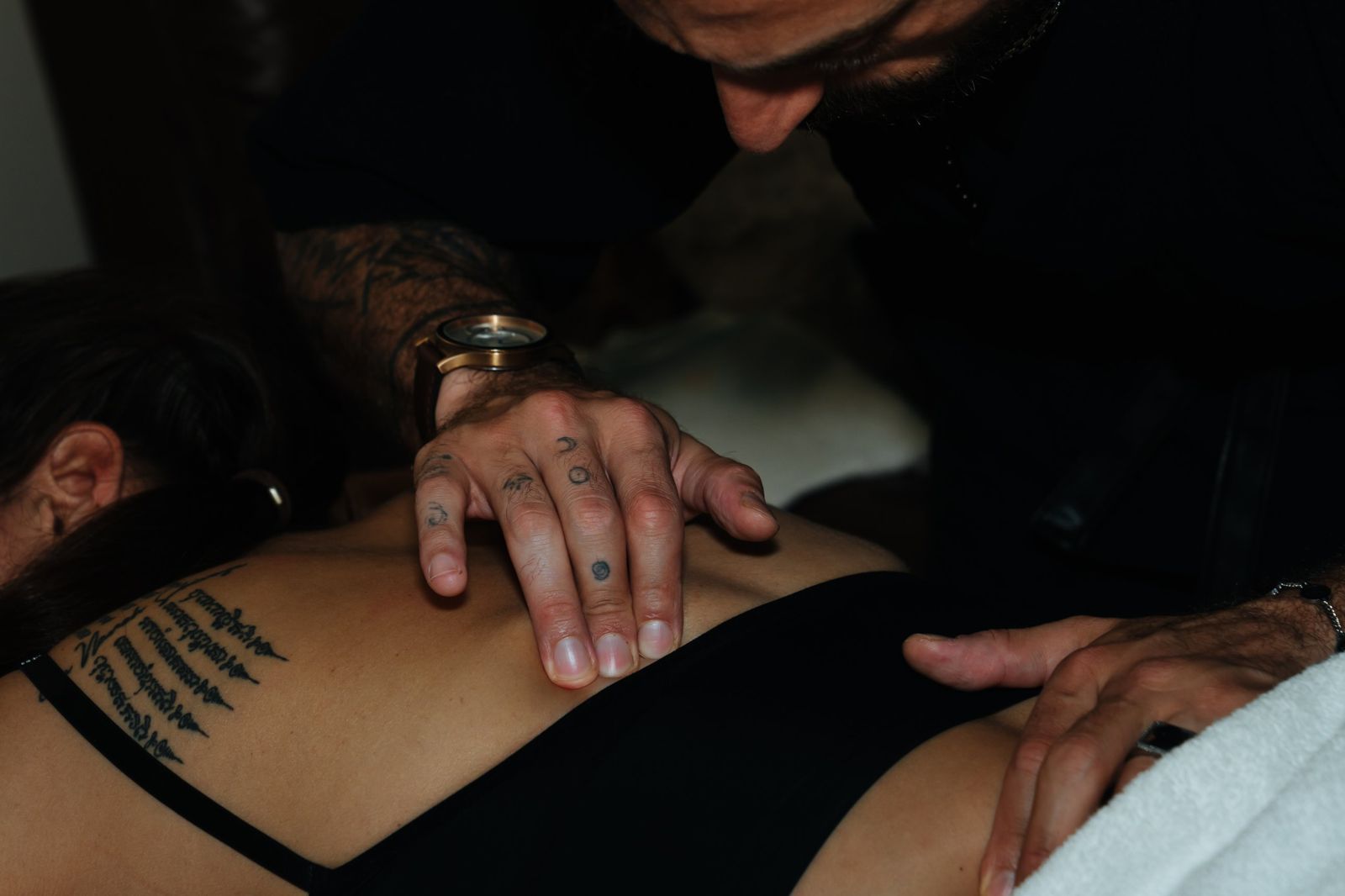
Every body tells its own story, so I start by listening: where it hurts, when it started, what you do all day, what you have already tried. Then I look and I feel. I compare left with right. Which side of the pelvis sits lower at the front and which sits higher at the back. Which foot rolls in. Which shoulder is forward. How the ribs and the breath move. That gives me a map of what has become short and tight and what has become long and tired.
Then I work in a deliberate order. First I release the shorter, tighter side with hands-on work, because that is what tells the nervous system it is safe to let go. Next come stretches for the area I just released, so the new length is used. After that, exercises that wake up the longer, quieter muscles, so they can do their share. Last is movement you do without thinking, the way you actually walk, squat and turn in real life. I check the bend-down again at the end, so you can feel the difference before you leave.
This is the part that makes the change last. Release on its own feels wonderful, but the body drifts back if nothing teaches it a better habit. Release, then retrain.
I recently completed Level8's Mastermind Fundamentals in movement therapy and biometrics optimisation, an intensive 32-hour course over four days taught by John Haddad, the movement therapist known for his work with Erling Haaland and Anthony Joshua. The assessment and the order of work above come from that course, and I use them in my sessions every week.
What can change
I do not promise a perfectly level pelvis, and nobody honest can. What I aim for is a body that moves more evenly and hurts less, and that is what people tend to notice first.
The tight side often feels looser within the first session, and the ache that sat on one side can ease. Squatting, climbing stairs and getting up from a chair can feel freer. Standing and walking can feel more balanced, with the weight landing more evenly on both feet. People who train often tell me their movement feels cleaner on the weaker side. Over a few weeks, as the new habits settle in, the body stops needing to compensate so hard, and that can show up as less end-of-day tension in the back, hips and neck.
None of this replaces medical care, and it works best alongside it. But if you have been told that everything looks fine and you still do not feel fine, this is a practical, hands-on place to start.

Three things you can try today
Share your weight. Most of us stand on one leg without noticing, with a hip pushed out to the side. For one day, catch yourself, bring your weight back to the middle and shift your feet often. It sounds too simple to matter, but you spend hours a day standing, and where the weight goes is how the pelvis learns its habits.
Do the bend-down check. Stand tall, then fold forward with your knees straight and let your arms hang. Notice where you feel the pull. The back of the legs is what we want. If the pull sits in one side of your lower back, or one side lifts higher than the other, you have just found a pattern worth a closer look.
Breathe low, twice a day. Put one hand on your belly and take five slow breaths through the nose, letting the belly and the lower ribs widen. The ribs and pelvis are linked, and a calmer, wider breath can soften the tension that holds them in place.

What it can look like in practice
To make this concrete, here is an example of how a session can go. It is an illustration, not a particular person.
Picture someone in their late thirties who works at a desk and runs at the weekend. Their lower back aches on the left, worse after a long day sitting. Their right hip pinches when they squat, and their trainers wear down on the same edge every time. They have had a scan, and it showed nothing serious.
When I compare left and right, the pattern is easy to read. The left side of the pelvis tips forward and the right side hikes up towards the ribs. The left foot rolls inwards, the right shoulder drifts forward, and the breath barely moves the lower ribs. Nothing is broken. Their body has found a way to cope, and it has been coping for years.
We release the tight side first, then stretch it, then wake up the glutes on the quieter side, and finish with a simple squat and a walk so the body practises the new position. At the end we repeat the bend-down, and they can feel the difference themselves. After that comes a short routine for the week, and we review how it feels at the next session.
That is the shape of the work: listen, map, release, retrain, and give the person something to take home. Everyone's pattern is different, which is why I always start with the map.
Where to start
The best first step is the Discovery Session, a 2-hour appointment with a full assessment and treatment in one. We talk, I map your left and right, and I work on what I find, so you leave with relief and a clear plan. Because it is the whole process in one visit, you also find out quickly whether this approach suits you. You can read more on the Healing page.
If you would rather start with movement, or you want to keep strengthening what we release, there are 60-minute physical rehabilitation sessions, in person or online. And if the pattern shows up in your training, I also work with clients one to one on functional training.
Frequently asked questions
Is it normal for one hip to be higher than the other?
Can bodywork fix uneven hips?
Do I need to stretch my tight side?
How many sessions will I need?
“Balance is not forced. It is allowed.”